
Welcome to Syracuse,
Phoenix Tower.
A 184-foot industrial structure in the I-90 Exit 37 infield. Syracuse winters. Highway-speed traffic. And a Florida-based developer that clearly hasn't checked the forecast.
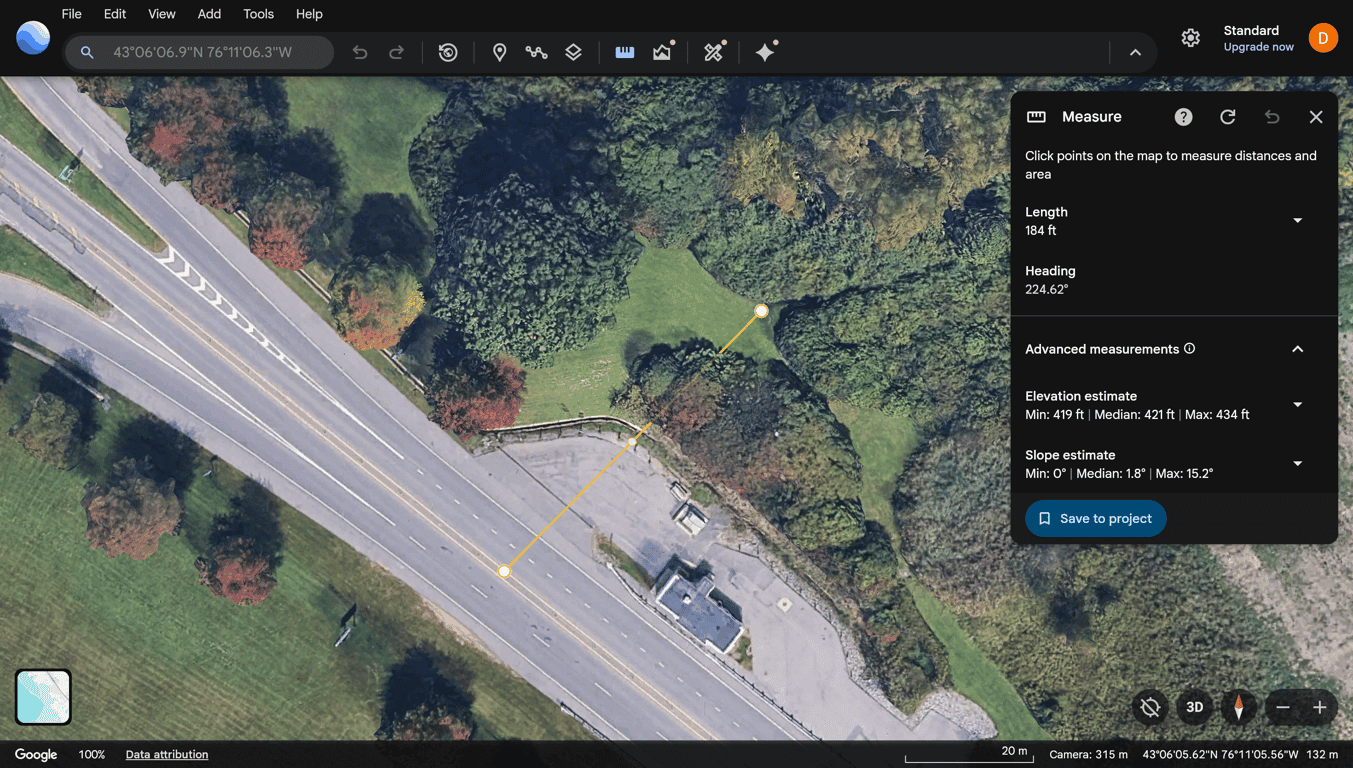
Physics vs. Promises
NYSTA allowed a 184-foot tower inside a highway infield. The developer claims it's safe. Gravity, local weather, and historical data say otherwise.
🧊 Lethal Ice Shedding
You might be thinking: other tall structures handle winter just fine. Here's how this is different.
Skyscrapers are heated, melting snow gradually, and are architected with ledges and catchments for pedestrian safety. A 184-foot monopole is a dead thermal sink with a sheer vertical drop. Under the cellular engineering standard (TIA-222), these structures are known to heavily accrete radial glaze ice. When the sun hits the dark metal, it doesn't just drip — it sheds.
This is a documented federal hazard. OSHA explicitly warns that ice falling from communication towers can travel 50 to 100 feet horizontally from the base, and even further when carried by high winds. Tower crews have documented "refrigerator-sized chunks" of ice flattening work vehicles parked below.
State highway departments routinely close traffic lanes under unheated steel structures due to ice-shed hazards. The Mackinac Bridge Authority regularly halts highway traffic due to falling ice from its steel towers, citing "garage door-sized sheets" shattering on the roadway and damaging vehicles.
Syracuse averages 127 inches of snow annually. Every freeze-thaw cycle is a potential ice-shed event. By placing this tower directly adjacent to an active I-90 ramp, the developer has introduced a documented projectile hazard to vehicles traveling at 65 mph.
~100 ft
Tower to off-ramp
50–100 ft
OSHA ice travel range
127"
Syracuse annual snow
65 mph
Ramp traffic speed
🔥 Uncontrollable High-Altitude Fires
Electrical faults in cell towers spark fires. Local fire departments do not possess ladder trucks capable of reaching 184 feet. If the top of this monopole catches fire, the fire department has to let it burn. Melting plastic, fiberglass, and cables will drop directly onto the active Interstate 90 on-ramp and surrounding brush.
There is no local mitigation plan for a tower fire over a highway ramp during rush hour.
🏗️ The "Hinge Point" Myth
Telecom engineers claim towers are designed with "hinge points" to fold rather than fall flat. But an engineered hinge point does not control the direction of the collapse. Severe wind and asymmetrical ice loading dictate where the steel goes.
If this tower folds at 90 feet and falls North or East, it hits trees. If it falls South or Southwest, tons of galvanized steel crash directly across the active I-90 ramp.
The developer introduced a structure where a 50/50 coin toss during a failure dictates whether it lands in the dirt or blocks emergency vehicles and causes a highway collision.
📂 New Disclosures from the May 8, 2026 FOIL Production
What the Documents Actually Show
NYSTA produced 81 documents on May 8, 2026 in response to FOIL Request #R000082-032026. The full set is hosted at /foil/ and catalogued at /the-facts/foil-evidence. Four findings directly impact highway safety. Each is sourced to a specific filename you can read for yourself.
⛽ The Diesel Operation They Never Mentioned
Documented in NYSTA Building Permit SYR-2025-003(issued December 2, 2025 by Code Compliance Specialist Joshua Stagnitti, expires December 1, 2028) and confirmed on AT&T’s construction drawings Rev 2 (Sheet T01) — a piece of equipment never disclosed in any public meeting or community-facing document:
A 30 kW diesel generator with a 145-gallon belly tank, mounted on a steel platform at grade inside a 50’×50’ fenced compound, approximately 100 feet from the active I-90 off-ramp.
Sources: NYSTA Building Permit SYR-2025-003; AT&T Construction Drawings Rev 2 (11/7/2025)
Risks the FOIL response does not address:
- Fuel-spill onto the highway— 145 gallons of diesel within the I-90 right-of-way drainage shed.
- Fire risk— an unattended fuel tank under a steel monopole that the local fire department cannot reach.
- Air-quality compliance— no Spill Prevention Control and Countermeasure (SPCC) plan or NSPS Subpart IIII compliance documentation produced.
- Stormwater runoff— the compound sits adjacent to delineated wetlands per the FOIL response.
- Refueling truck ingress— diesel deliveries via a tanker on a highway off-ramp shoulder, recurring for the life of the tower.
None of this was raised in a public meeting because there was no public meeting. None of it was raised in environmental review because, as NYSTA confirmed in the same FOIL response, no Alternative Site Analysis was ever conducted.
📐 What Sabre Industries Designed — In Their Own Numbers
The 184-foot monopole was designed by Sabre Industries, Inc. of Alvarado, Texas. Engineer of record: Robert Beacom, sealed July 15, 2025 (license expires July 31, 2026). The 36-page sealed structural design report (Job 25-3277-JDS-R1, Rev B) discloses every design parameter that goes into the tower’s safety calculations.
| Parameter | Value | Notes |
|---|---|---|
| Standard | ANSI/TIA-222-H | NY Building Code Chapter 35 references the older TIA-222-G-2005 |
| Wind speed (no ice) | 109 mph | 3-second gust |
| Wind speed (with ice) | 40 mph | 3-second gust |
| Design ice thickness | 1.50 inches | Drives ice-shedding throw analysis — see below |
| Risk Category | II | Lowest meaningful category — arguably should be III given highway/residential proximity |
| Site Class | D (DEFAULT) | Not field-verified |
| Base Moment | 6,352.75 ft-kips | Overturning load the foundation must resist |
| Base Axial / Shear | 69.92 kips / 48.07 kips | At design wind |
| Top Deflection / Sway | 9.54 ft / 4.99° | At design wind |
| Foundation | Two options designed | Type undecided in this report |
The Risk Category II selection is the cost-savings choice. ANSI/TIA-222-H assigns Risk Category III to structures whose failure “would cause a substantial impact on health, safety, environment, or essential services.” A 184-foot tower ~100 feet from an active I-90 off-ramp, adjacent to R-O residential zoning, with 145 gallons of diesel fuel and three-carrier commercial 5G equipment, plausibly meets that bar. Risk Category II reduces required design loads — an engineering choice with cost implications.
The Sabre structural report lists Site Class D as a default. To its credit, the project’s geotechnical investigation backs that up: the Delta Oaks / Tectonic boring (B-1, drilled 11/6/2024 to 50 ft) independently characterizes the subsurface as Seismic Site Class D, showing wet, layered silty sand transitioning to wet sandy silt with rock fragments and groundwater at 28.10 ft. So the site class itself is defensible — the unresolved structural questions are the standards mismatch (TIA-222-H vs. the NY-code 222-G-2005) and the drilled-pier vs. pad/pier foundation mismatch NYSTA closed without a reconciliation memo.
Source: 25-3277-JDS-R1-RB Permit Package — Sabre Industries Structural Design Report (Rev B)
📐 The Tower Is Built to a Standard Not in the NY Building Code
The structural design uses the cellular tower industry standard ANSI/TIA-222-H (current revision). New York State Building Code Chapter 35 references the older 222-G-2005 standard. NYSTA’s own engineer flagged this in writing.
“ANSI/TIA-222-H structural standard used; NY State Building Code Chapter 35 only references the older ‘222-G—2005’ standard.”
— NYSTA review item #3, 8/27/2025; carried unresolved into 11/6/2025 AT&T Round 2. PTI’s response was simply “DRAWINGS UPDATED.” The standards mismatch was never reconciled in writing in the production. Source: Exit_37_Cell_Tower_AT_T_8-27-2025.docx, Exit_37_Cell_Tower_AT_T_Review__2_11-6-2025.docx.
The two standards differ in wind-load assumptions, ice-load assumptions, and analysis methodology. Either the tower is built to a code New York doesn’t adopt, or it is built to a code NYSTA didn’t produce documentation for. We’re still asking which.
📏 Verizon’s First-Round Footer Was Below NY Code Minimum
On the first round of plan review, Verizon’s structural footer for its co-located equipment was submitted at 3’-6” deep. New York Code minimum: 4’ deep to bottom of footer to finish grade.
4’-0”
Code minimum
3’-6”
As submitted
Source: Verizon_Exit_37_Review_10-3-2024.docx (filename misnamed; internal review date 10/3/2025), item C-8 Detail 2. The same engineering firm (Tectonic Engineering) authored the geotechnical investigation. Verizon revised in the second round on 10/10/2025.
Six inches below code on the first round — on a 184-foot monopole adjacent to an active highway off-ramp — is not a clerical typo. It is the kind of error that NYSTA’s engineering review is supposed to catch before the application clears, not after the public files a FOIL.
🏗️ The Foundation Type Did Not Match the Structural Analysis
The TEP Engineering Structural Analysis Report calculated tower loads against a drilled pier foundation. The approved Construction Drawings show a pad/pier foundation.
“This report mentions a drilled pier foundation that does not match up with the approved construction plans for the tower.”
— NYSTA review item #18, 8/27/2025, carried into 11/6/2025 AT&T Round 2. Source: Exit_37_Cell_Tower_AT_T_8-27-2025.docx.
A foundation-type mismatch between the structural analysis input and the as-built design is a textbook safety review trigger. NYSTA closed this item without producing the reconciliation memo — the document showing that the loads were re-calculated against the actual foundation. We’ve asked. It is not in the production.
🧊 Ice-Shedding Hazard — Calculated From Sabre’s Own Numbers
Until May 8, 2026, the campaign’s ice-shedding analysis cited OSHA’s 50–100 ft horizontal heuristic applied to a generic 184-ft tower in Syracuse weather. Now, with the Sabre design report in hand, we have project-specific design parameters:
184 ft
Total height (180’ pole + 4’ lightning rod)
1.50”
Design ice thickness (Sabre)
109 mph
Design wind speed (Sabre)
~100 ft
Tower base to active off-ramp
These are not abstract numbers. They are the design assumptions the manufacturer used to engineer the structure. A 184-ft tower designed to accumulate 1.5 inches of radial ice in 109 mph design wind is, by any reasonable application of OSHA’s 50–100 ft horizontal-throw heuristic, a documented projectile hazard above an active highway off-ramp.
The campaign’s next step is a project-specific ice-shed calculation using these inputs. Until then, the responsible parties — PTI, NYSTA, and the FHWA — can produce one. Our position remains: Sabre’s design parameters are public now. The ice-throw envelope follows from physics. Either someone calculates it, or the public should know it has not been calculated.
Source: Sabre Industries Structural Design Report Rev B (7/15/2025).
🏛️ The Jurisdiction Trap
How They Got Away With It
If you look at a map, I-90 Exit 37 and Electronics Parkway are in the Town of Salina. So how did a developer build a 184-foot hazard right next to a neighborhood without a single Town of Salina safety inspection, zoning board hearing, or environmental review?
They used a legal loophole.
Phoenix Tower International (PTI) knew the Town of Salina would enforce strict fall-zone setbacks and deny a private permit. So, they partnered with the New York State Thruway Authority (NYSTA). NYSTA operates as a sovereign state entity. By dropping the tower inside the highway infield, the developer invoked NYSTA's sovereign immunity to completely bypass local zoning. The Town was legally powerless to stop it.
The Loophole on Paper
A cell tower needs grid power. We submitted a Freedom of Information Law (FOIL) request to the Town of Salina Code Enforcement Office asking for the electrical, street-cut, or right-of-way permits for this tower.
The Town's response: They possess ZERO records.
Under state franchise rights, public utilities like National Grid can execute "Utility Work Agreements" directly with the State to work inside highway right-of-ways, bypassing local building inspectors entirely.
A telecom developer exploited state highway loopholes to build a 184-foot tower 0.25 miles from an airport and 1.25 miles from a protected eagle roost — specifically to ensure local residents, town building inspectors, and state wildlife biologists had no legal authority to review it.
Our Demand
We demand the Federal Highway Administration (FHWA) and the New York State Public Service Commission (NYS PSC) intervene and produce the independent engineering reviews that justify placing this unvetted hazard inside a federal highway clear zone.
FHWA
Produce an independent ice-shed analysis, fire mitigation plan, and a site-specific collapse radius study showing clearance distances from active travel lanes.
NYS PSC
Investigate the commercial utility infrastructure installed at this site without standard local environmental (SEQRA) or municipal building department oversight.
The FAA gets the birds. The FHWA gets the ice. The NYS PSC gets the grid connections. If no one reviewed this, everyone failed.
We're Not Alone
Communities across New York State and the country have been fighting back for years against towers just like this one.
In the News — This Is Happening Everywhere
Join your neighbors. Make your voice heard.
Continue Reading
← Aviation & Flight Safety
FAA obstruction rules, 5G altimeter interference, and the Part 77 exploit.
Wildlife & Environment
100+ bald eagles 1.25 miles away. No USFWS consultation. Zero DEC records.
Community & Land Value →
Property values, the state land loophole, and what federal law says you can't argue.