
Eagles Don't Avoid Towers.
They Land on Them.
100+ bald eagles. 1.25 miles away. No environmental review provided. No USFWS consultation on record. An industry already destroying eagle nests across America.
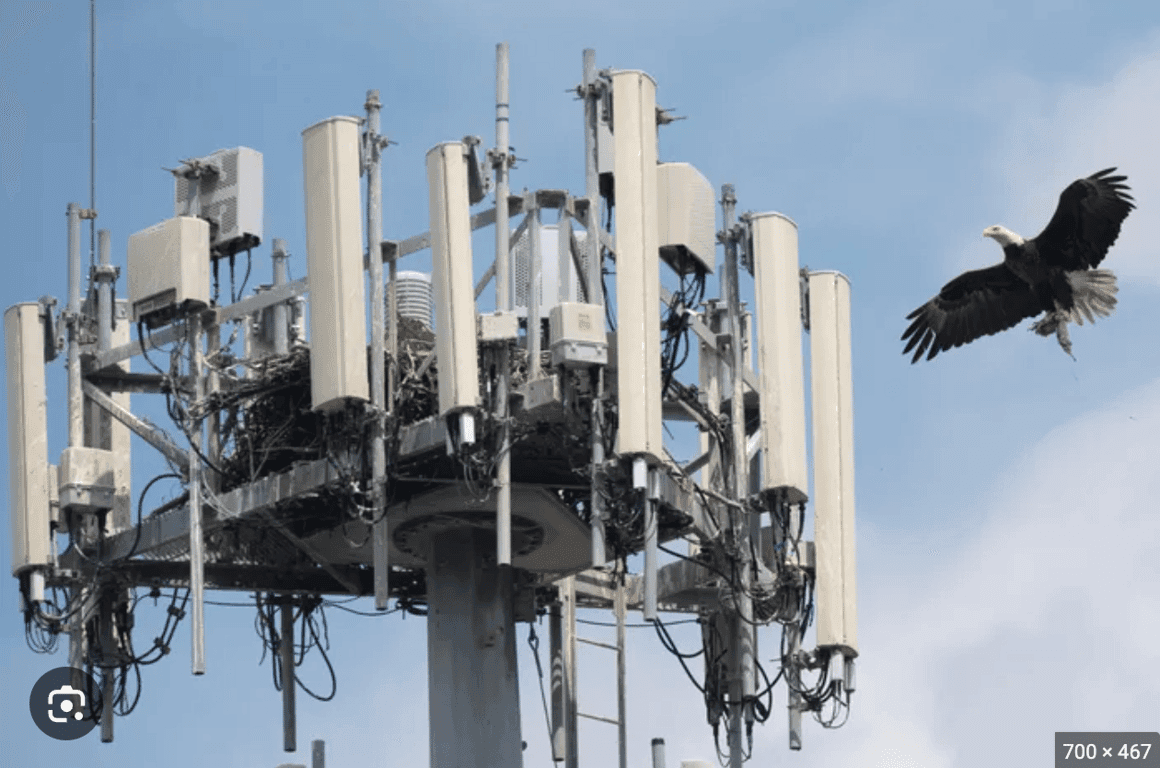
Eagles nest on cell towers. When 5G upgrades arrive, the platforms — and the nests — get removed.
🦅 Bald Eagle Protection Act • Federal Law
We Asked for the Environmental Reviews. They Don't Exist.
Federal guidelines require environmental review when siting towers near protected habitat. Onondaga Lake hosts 100+ federally protected bald eagles — the largest urban wintering roost in New York State. This tower sits 1.25 miles away, within their confirmed foraging range.
📄 FOIL Response: NYS DEC Has Zero Records
On March 25, 2026, we filed a Freedom of Information Law (FOIL) request with the NYS Department of Environmental Conservation (DEC), Region 7, requesting any Environmental Assessment Forms (EAFs), SEQRA determinations, wildlife impact assessments, or correspondence related to the tower at 474 Electronics Parkway.
On April 1, 2026, the DEC responded:
“Please be advised that a diligent search of the files maintained by DEC produced no responsive records.”
— Region 7 FOIL Coordinator, NYS Department of Environmental Conservation, FOIL #W162712-032526, April 1, 2026
No EAFs. No SEQRA review. No wildlife consultation. No correspondence between the DEC and NYSTA or PTI. The state's own environmental agency has zero records related to a 184-foot tower being built 1.25 miles from the largest urban bald eagle roost in New York State.
What We Do Know
Audubon: Eagles Nest on Cell Towers — Then Lose Their Homes
The Audubon EagleWatch Program reports 20% of monitored bald eagle nests in Florida are on human-made structures — including cell towers. In some counties, 60% of all nests are on man-made structures.
Audubon Florida — EagleWatch (Oct 2024)5G Upgrades Destroy Eagle Nests Nationwide
When telecoms upgrade to heavier 5G equipment, they remove the platforms eagles nested on. Eagles returning in 2023–2024 found nests gone — with no platform, they couldn't rebuild. Current USFWS permits allow removal but don't prohibit permanent alterations that prevent future nesting.
"Eliminating cell phone towers as possible nest sites could have a negative impact on nesting success for Florida's Bald Eagles." — Audubon EagleWatch
⚠️ This Tower Is a Trap for Onondaga Lake Eagles
At 184 feet — nearly twice the height of highway light poles — this tower will be the tallest structure near Onondaga Lake. With 100+ eagles 1.25 miles away, it's not if they find it — it's when. Tower goes up → eagles nest → telecom upgrades → nest destroyed. Audubon has documented this cycle across Florida. 6G is already in development — more upgrades, more nest removals for decades.
It Already Happened
Mount Pleasant, SC: Eagle Nest Illegally Removed from Cell Tower
In January 2023, workers removed a bald eagle nest from a cell tower in Mount Pleasant, South Carolina — without a permit from U.S. Fish & Wildlife. Removing an active raptor nest without federal authorization is a violation of the Bald and Golden Eagle Protection Act and a federal offense. The mayor called it "appalling." Wildlife experts warned it could disrupt breeding season.
This is not hypothetical. This is exactly the cycle we are warning about: tower goes up → eagles nest → telecom needs upgrades → nest gets destroyed. It has already happened. It will happen again.
Source: WPDE ABC15, January 2023 — "Controversial bald eagle nest removed from cell tower in Mount Pleasant; Wildlife experts weigh in"
USFWS: Site Towers Away From Roosts
USFWS guidelines state towers should be sited "away from nests, foraging areas, and communal roost sites." Required buffers: ½-mile (2,640 ft) from communal roosts with line of sight, and 660 ft from any nest. Were these evaluated? No documentation has been produced.
USFWS Bald Eagle Management Guidelines (PDF)The Tower Is in Eagle Territory
Eagle territories span 2.5–15 square miles. At 1.25 miles from the roost, this tower sits squarely within foraging range. Liverpool residents confirm eagles regularly fly over the area.
National Audubon SocietyAdditional Concern
Peer-Reviewed: RF Radiation Harms Birds Near Towers
Research in Electromagnetic Biology and Medicine (Balmori, 2006) documented population decline, nest abandonment, and increased mortality near tower base stations. White stork nests within 200m showed significantly lower breeding success. Eagles perching directly on antennas face the highest possible RF exposure.
Protected under the Bald and Golden Eagle Protection Act. Fines up to $250,000 and criminal prosecution. Was this tower sited in compliance with federal wildlife guidelines? We asked. The DEC has zero records. NYSTA is still stalling.
📂 May 8, 2026 FOIL Production — NYSTA SEQRA Determination
SEQRA Said “No Effect” on the Bald Eagle. Here's What That Was Based On.
On May 8, 2026, NYSTA produced its full SEQRA review file in response to FOIL Request #R000082-032026. NYSTA’s FEAF Part 3 evaluation — written by NYSTA acting as the self-designated Lead Agency on its own land lease — reaches the following conclusion about the bald eagle:
“The project area does not provide suitable habitat for the Bald Eagle; therefore, the project ‘No Effect’ on the Bald Eagle.”
— NYSTA, FEAF Part 3, transmitted to the Town of Salina with the SEQRA Determination Letter.
What this conclusion was actually based on:
The supporting analysis cited by NYSTA is the USFWS Northeast Determination Key — a self-serve web tool that an applicant fills out themselves to receive an automated screening result. It is not a USFWS letter. It is not a formal Section 7 consultation under the Endangered Species Act. It is not a site visit. It is a checkbox interview conducted with no biologist in the loop.
No bird-flight-path study is attached to the SEQRA file. No project-specific roost survey. No correspondence with a USFWS field biologist. NYSTA’s May 8, 2026 production of 93 documents contains zero records of any direct USFWS consultation.
What the documented record actually shows:
- 100+ federally protected bald eagles winter at Onondaga Lake — the largest urban bald eagle wintering roost in New York State — 1.25 miles from this tower.
- Audubon EagleWatch and direct field observation by Liverpool residents document eagles regularly traveling over the project area.
- Bald eagle territories span 2.5–15 square miles. At 1.25 miles from the roost, this tower sits squarely within foraging range.
- The Audubon EagleWatch Program has documented bald eagles nesting on cell towers at rates of 20%–60% of monitored nests in similar regions.
A paper conclusion of “no suitable habitat” reached via a self-screening web tool is not the same as a field-verified, USFWS-signed habitat determination. NYSTA reviewed itself, and NYSTA gave itself a clean bill of health. The bald eagle — protected under federal law, with criminal penalties up to $250,000 for take — was dismissed in a single sentence supported by an automated checkbox.
Source: SEQRA_Determination_Letter_to_Salina__final__w_att.pdf and USNY2029_NYSTA_SEQRA_R3_Final.pdf. Full FOIL catalog at /the-facts/foil-evidence.
The Birds: 7 Million Deaths Per Year
The American Bird Conservancy reports towers kill 7 million birds per year in North America — primarily nocturnal migrants disoriented by tower lights.
Dead vultures found at the base of the tower site in Liverpool, NY.
100+
Bald Eagles at Onondaga Lake
The largest urban bald eagle wintering roost in New York State — directly adjacent to the tower site. Protected under the Bald and Golden Eagle Protection Act.
Lose-Lose
Lights Don't Fix This
No lights? Birds can't see it. Steady lights? Attract and disorient birds, causing more deaths. Flashing lights still kill 30% of what steady lights do. No version of this tower is safe.
Turkey vultures at the site are federally protected under the Migratory Bird Treaty Act. As large, slow-soaring raptors, they're among the most collision-prone species.
American Bird Conservancy: Tower CollisionsThe Bees: Peer-Reviewed and Devastating
Peer-reviewed research proves cell tower RF radiation decimates honeybee populations — disrupting navigation, reducing colony strength, and triggering collapse. Honeybees pollinate one-third of all food humans eat.
Peer-Reviewed Study: RF Effects on HoneybeesPeer-Reviewed • NIH / PubMed Central
The Entire Ecosystem Is at Risk
A 2022 study in Reviews on Environmental Health reviewed EMF effects across all wildlife and plant species: current safety standards offer zero protection for any non-human species — and the harm is already measurable.
390–570%
More Radiation Absorbed by Insects Under 5G
5G wavelengths match insect body size, creating a resonance effect — up to 570% more absorption vs. 4G. "Devastating holes in the food web."
ZERO
Wildlife Safety Standards
FCC/ICNIRP guidelines are strictly human-centric — protecting only against short-term tissue heating. No protection for birds, bees, trees, or any other species.
Man-Made EMFs Override Natural Navigation
Migratory birds, bees, bats, and sea turtles navigate via Earth's magnetic field using magnetite crystals and cryptochrome proteins. Artificial tower EMFs overwhelm these sensors — causing disorientation, failed migrations, and population decline.
Documented Effects by Species
🐝 Pollinators
Impaired memory & smell, hive abandonment, reduced egg-laying, increased mortality — linked to colony collapse disorder.
🦅 Birds
Compromised immunity, altered behavior, harmed chick development, disrupted migration, nest abandonment near towers.
🌳 Trees & Plants
9-year field studies show visible canopy damage, root decline, and altered cellular growth in exposed trees.
1,200+ Studies Reviewed • Environmental Health Trust
The Most Comprehensive RF & Wildlife Review Ever Published
Researchers reviewed 1,200+ peer-reviewed studies on wireless radiation effects on flora and fauna. The majority found adverse effects — even at exposures far below FCC limits:
Reproduction & Development
Stunted growth and increased embryo mortality across species.
Navigation & Orientation
Disruption of biological sensors animals use to migrate and survive.
Cellular Health
Oxidative stress, DNA damage, and disrupted metabolism.
5G Makes It Worse
Hundreds of thousands of new antennas push radiation closer to ground-level habitats — without environmental review.
⚖️ EHT v. FCC — The Court Agreed
The Environmental Health Trust sued the FCC and won. The U.S. Court of Appeals ruled the FCC acted unlawfully by ignoring scientific evidence of harmful environmental impacts — validating the need for ecosystem-inclusive regulations.
An unlit, 184-foot tower in documented eagle habitat, adjacent to New York's largest urban eagle roost, surrounded by vultures and honeybees — with no public environmental review. 1,200+ studies confirm harm. A federal court confirmed the FCC ignored it. If a protected species is killed, someone is legally liable. We'll be watching.
Now You Know. Now Do Something.
Sign the petition, call your representatives, and show up to the next Town Board meeting. They ignored us once—make sure they can't again.
Take Action Now